 ultimate-guide
What to Expect When Buying Your First Home: A Complete Guide
Table of Contents
- Financial Preparation and Understanding Mortgage Pre-Approval Requirements
- Credit Score and Debt-to-Income Ratio: What Lenders Require
- How Long Does the Home Buying Process Take
- Down Payment, Earnest Money, and Saving for Your Purchase
- The Home Inspection and Appraisal Process
- Closing Costs for Buyers and Hidden Expenses
- First-Time Home Buyer Programs and Financial Assistance
- The Emotional and Practical Reality of Buying Your First Home
Last Updated: August 5, 2026
Financial Preparation and Understanding Mortgage Pre-Approval Requirements
Pre-approval is a formal commitment from a lender that you can borrow a specific amount based on a thorough review of your financial situation. This distinction from pre-qualification matters because it signals to sellers that you're a serious buyer.
Assess Your Budget and Get Pre-Qualified
Before meeting with a lender, assess your budget honestly by calculating how much you can realistically afford without overextending yourself. Consider your income, existing debt, savings, and monthly expenses. Many first-time buyers stretch their budget to the maximum the lender approves, only to discover the monthly payment leaves little room for other obligations.
Pre-qualification is an informal estimate of how much you might borrow based on information you provide. Pre-approval involves submitting actual financial documents, tax returns, pay stubs, bank statements, and employment verification. The lender pulls your credit report and verifies your information before issuing a pre-approval letter.
Getting pre-approved before house hunting gives you a clear budget ceiling, shows sellers you're qualified to close, and accelerates the offer-to-closing timeline. When competing against other buyers, pre-approval can be the difference between winning and losing an offer.
What Lenders Look For During Pre-Approval
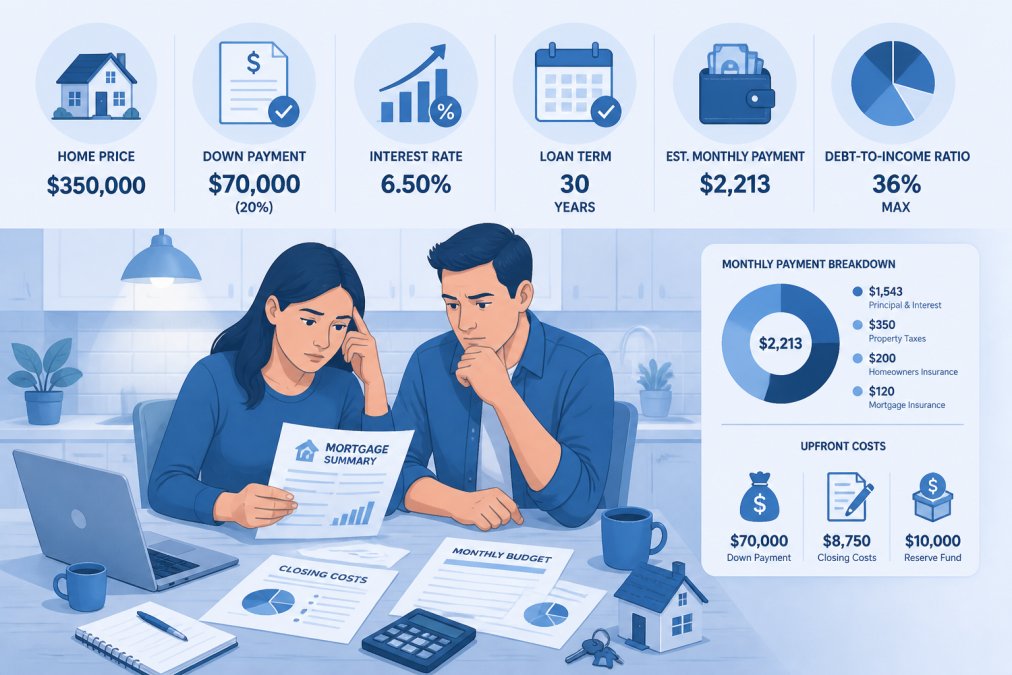
Your debt-to-income ratio is critical. This is the percentage of your gross monthly income that goes toward debt payments, including the proposed mortgage payment. Most lenders want to see a ratio below 43 percent.
Employment history matters as well. Lenders want stable income, ideally from the same employer for at least two years. Self-employed borrowers need to provide two years of tax returns and profit-and-loss statements.
Savings and reserves strengthen your application. Lenders prefer to see additional savings beyond down payment and closing costs, demonstrating financial discipline and providing a cushion for unexpected expenses.
Credit Score and Debt-to-Income Ratio: What Lenders Require
Your credit score summarizes your borrowing history and repayment behavior, generated by credit bureaus based on payment history (35 percent), amounts owed (30 percent), length of credit history (15 percent), credit mix (10 percent), and new credit inquiries (10 percent).
Most conventional mortgage lenders require a minimum credit score of 620, but competitive rates typically start at 740 or higher. If your score is below 620, you may qualify for a Federal Housing Administration loan with more flexible credit requirements. The difference between a 680 score and a 760 score can mean a quarter-point or more in interest rate, a significant difference over a 30-year mortgage.
The debt-to-income ratio includes all monthly debt obligations: car loans, student loans, credit card minimums, alimony, child support, and the proposed mortgage payment. Paying down existing debt before applying for a mortgage can dramatically improve your approval odds and terms.
How Long Does the Home Buying Process Take
The timeline from deciding to buy to closing typically spans three to six months, though this varies based on market conditions, your financial readiness, and transaction complexity.
The Timeline From Offer to Closing
Once you find a home and make an offer, the seller has a few days to accept, counter, or reject. If accepted, you enter the due diligence period, typically lasting 10 to 14 days, during which you arrange a home inspection, order an appraisal, and review property documents and disclosures.
Your lender orders the formal appraisal, which takes one to two weeks. Simultaneously, the underwriting team reviews your complete financial package and property details. Underwriting can surface requests for additional documentation, extending the timeline by several days.
The final walkthrough happens 24 to 48 hours before closing to verify repairs were completed and the property is in expected condition. Closing itself is a single appointment where you sign documents, transfer funds, and receive keys, typically lasting one to three hours.
Factors That Slow Down or Speed Up the Process
Market conditions significantly affect timeline. In a seller's market, sellers may push for faster closing. In a buyer's market, you have more flexibility to negotiate longer periods.
Appraisal delays are common. If the appraisal comes in lower than the purchase price, you may need to renegotiate, request a second appraisal, or make up the difference in cash. Title issues, liens, or ownership disputes require resolution before closing and can delay everything. Having your mortgage pre-approval in place before making an offer is one of the best ways to accelerate the process.
Down Payment, Earnest Money, and Saving for Your Purchase
The down payment is your initial cash contribution toward the purchase, expressed as a percentage of the purchase price. While 20 percent has been traditional, first-time buyers often put down less.
Down payments as low as 3 percent are available through conventional loans, and Federal Housing Administration loans accept 3.5 percent. Veterans may qualify for VA loans with zero down payment. Lower down payments result in higher monthly payments and, for conventional loans below 20 percent, private mortgage insurance.
Earnest money is a deposit you make when your offer is accepted, typically one to three percent of the purchase price, demonstrating your commitment. If you back out without valid reason, you lose it. If the sale closes, it's credited toward your down payment and closing costs.
Many first-time buyers benefit from first-time buyer programs offering grants, low-interest loans, or down payment assistance. Some employers offer down payment assistance as an employee benefit. Family gifts are another common source; lenders allow gift funds with a letter stating it's a gift, not a loan.
The Home Inspection and Appraisal Process
Two separate evaluations happen during buying: the home inspection and the appraisal, serving different purposes and conducted by different professionals.
What Happens During a Home Inspection
The home inspection is your opportunity to identify defects, safety issues, and deferred maintenance before you're obligated to buy. You hire an independent home inspector, typically paying $300 to $500. The inspection takes two to three hours and covers structure, roof, foundation, plumbing, electrical, HVAC, and appliances.
The inspector provides a detailed report listing issues by severity: critical safety concerns, major repairs needed, minor issues, and maintenance recommendations. Armed with this information, you can renegotiate the purchase price, request the seller to make repairs, ask for a credit toward repairs you'll handle yourself, or walk away if issues are extensive.
Understanding the Appraisal and Its Impact
The appraisal is an independent assessment of the property's market value, ordered by your lender to ensure the home is worth what you're paying. The appraiser compares your property to recently sold comparable homes, adjusting for differences in size, condition, location, and features. The appraisal typically costs $400 to $600 and takes one to two weeks.
If the appraisal comes in at or above your purchase price, you're fine. If it comes in below, you can renegotiate the purchase price downward, make up the difference in cash, request a second appraisal, or walk away.
Closing Costs for Buyers and Hidden Expenses
Closing costs are fees and expenses associated with finalizing the mortgage and transferring ownership, typically ranging from two to five percent of the purchase price. For a $300,000 home, expect $6,000 to $15,000 in closing costs.
What's Included in Closing Costs
Common closing costs include loan origination fee, appraisal fee, title search and insurance, homeowners insurance premium, property taxes, attorney fees, and recording fees. Your lender must provide a Loan Estimate within three business days of application, itemizing all anticipated closing costs. The final Closing Disclosure is provided at least three business days before closing.
Some closing costs are negotiable. In a buyer's market, you may ask the seller to cover some costs. Lender fees vary, so shopping around can reduce closing costs. Property taxes are prorated based on closing date. Homeowners insurance is required by lenders and must be in place before closing.
Budget for Post-Closing Maintenance and Repairs
Many first-time buyers arrive at closing with depleted savings. Budget for at least one percent of the home's purchase price annually for maintenance and repairs. For a $300,000 home, that's $3,000 per year or $250 per month. In the first year, plan for higher expenses as you address deferred maintenance and handle post-closing surprises.
Keeping a maintenance reserve separate from your emergency fund helps ensure you can handle expenses without derailing your financial plans.
First-Time Home Buyer Programs and Financial Assistance
Multiple programs exist to help first-time buyers. Federal Housing Administration loans allow down payments as low as 3.5 percent with credit scores as low as 580. VA loans, available to military service members and veterans, often require zero down payment. USDA loans serve rural and suburban areas and also allow zero down payment for qualified borrowers.
State and local programs vary widely. Many states offer down payment assistance grants or low-interest loans. Some localities offer tax credits or property tax abatements. Employer programs sometimes include down payment assistance. Nonprofit organizations often provide homebuyer education classes, which some lenders require and which can unlock additional assistance.
Research programs specific to your state and area. A real estate agent familiar with the local market can point you toward relevant programs.
Working With a Real Estate Agent and Finding Professional Support
Hiring a real estate agent is highly advisable for first-time buyers. A good agent serves as your advocate, educator, and negotiator. In most transactions, the seller pays agent commissions, so using an agent costs you nothing directly.

A skilled agent knows the local market intimately, which neighborhoods are appreciating, where to find good value, and what comparable homes have sold for recently. An agent also handles logistics: scheduling inspections, coordinating with lenders, managing paperwork, and ensuring deadlines are met.
When selecting an agent, look for someone with experience in your target market, strong communication skills, and a track record of successful transactions. A good agent asks questions about your needs, timeline, and budget. Bernie Krause, serving the East Valley real estate market, works with first-time buyers regularly and understands the specific dynamics of communities like Chandler, Gilbert, and Scottsdale.
Beyond your agent, you'll interact with a loan officer, underwriter, home inspector, appraiser, and title company representative. Don't hesitate to ask questions when you don't understand something.
The Emotional and Practical Reality of Buying Your First Home
Buying your first home is simultaneously exciting and stressful. The financial commitment is substantial, the process involves multiple unknowns, and the stakes feel high.
Managing the Stress and Uncertainty
The uncertainty is real. You're making one of the largest financial decisions of your life based on incomplete information. Manage stress by staying informed. Understand each step of the process before it happens. Read your Loan Estimate and Closing Disclosure carefully. Ask your lender, agent, and inspector to explain anything unclear.
Set realistic expectations. Most home purchases close successfully. Having contingencies in place, inspection contingencies, appraisal contingencies, financing contingencies, protects you if problems arise. Build a support network by talking to friends and family who've bought homes. Working with professionals you trust makes the process significantly less stressful.
Remote and Virtual Homebuying Workflows
For buyers relocating from out of state or unable to visit properties in person, remote homebuying workflows have become increasingly viable. Video tours, virtual inspections, and remote closing are now standard offerings.
High-quality video tours show room flow, lighting, storage, and finishes. Some agents offer FaceTime or Zoom walkthroughs where you can ask questions in real time. Many inspectors offer live video during inspection, allowing you to see issues as they're discovered. Closing can happen entirely remotely using electronic signatures and remote notarization in most states.
The main limitation of remote buying is that you can't physically tour the home before closing. Many buyers mitigate this by hiring a local inspector or trusted friend to visit on their behalf, or by scheduling a final walkthrough shortly before closing.
Buying your first home is a substantial undertaking, but it's manageable when you break it into steps and understand what to expect. Working with experienced professionals who understand your local market makes an enormous difference. Bernie Krause guides first-time buyers through every phase of the process, answering questions, managing logistics, and ensuring you feel confident in your decision. Ready to take the next step? Connect with Bernie Krause to start your first-time homebuying journey in the East Valley.
Frequently Asked Questions
What is the 3-3-3 rule for buying a house?
The 3-3-3 rule is an informal guideline suggesting you spend 3 months getting pre-approved and saving, 3 months searching for homes, and 3 months closing on your purchase. While timelines vary based on market conditions and your specific situation, this rule helps first-time buyers plan their timeline realistically. In Arizona's competitive East Valley market, the search phase may compress if you find the right property quickly.
How much cash do I need upfront to buy a first home?
Most lenders require a down payment between 3-20% of the home's purchase price, though first-time buyer programs can go as low as 0-3% down. Beyond the down payment, you'll need earnest money (typically 1-3% of the offer price) to show serious intent, plus closing costs (2-5% of the loan amount). Total upfront cash usually ranges from 5-10% of the home's price, though this varies by program and lender.
What are the hidden costs of buying a first home?
Beyond closing costs, first-time buyers often overlook property taxes, homeowners insurance, HOA fees, home inspection costs, appraisal fees, and private mortgage insurance (PMI) if putting down less than 20%. Post-closing, budget for immediate repairs, maintenance reserves, and utility setup. In Arizona communities like Chandler and Gilbert, property taxes and insurance vary by location, so factor these into your overall budget before making an offer.
Can I afford a $300,000 house on a $70,000 salary?
Affordability depends on your debt-to-income ratio, down payment size, and interest rates. Most lenders cap your total monthly debt payments at 43% of gross income. On a $70,000 salary, that's roughly $2,500 per month for all debts. A $300,000 mortgage at current rates typically requires $1,200-1,400 monthly, leaving room for other debts. Working with a mortgage lender to review your full financial picture is essential before committing.
What should I expect during the home inspection process?
A home inspector examines the structure, roof, HVAC, plumbing, electrical systems, and appliances, typically spending 2-4 hours on the property. You can attend and ask questions. The inspector provides a detailed report listing any issues found. If major problems surface, you can negotiate repairs, credits, or a price reduction with the seller. This contingency protects you from buying a home with costly hidden damage.
What first-time home buyer programs are available to me?
Federal programs include FHA loans (3.5% down), VA loans (if military), USDA loans (for rural areas), and conventional loans with first-time buyer advantages. Arizona and local programs may offer down payment assistance, tax credits, or favorable interest rates. The HUD website and your state housing authority list current programs. A mortgage lender can discuss which programs match your income, credit, and purchase location in the East Valley.
How do interest rate changes affect my buying power?
A 1% increase in interest rates can reduce your buying power by 10-15%, meaning the same monthly payment buys a less expensive home. Rising rates also increase your monthly mortgage payment on a fixed-rate loan. Conversely, falling rates let you afford more or lower your payment. Locking in a rate during pre-approval protects you temporarily, but rates can shift before closing. Monitor rate trends and discuss rate-lock options with your lender.
How long does the entire home buying process typically take?
From pre-approval to closing usually takes 30-45 days, though timelines vary. Pre-approval itself takes 3-5 days. Once you make an offer, inspections and appraisals add 1-2 weeks. Underwriting and final approval take another 5-10 days. In competitive Arizona markets like Chandler and Gilbert, the search phase may be shorter if inventory is tight. Delays can occur if the appraisal comes in low or issues surface during inspection.
This article was written using GrandRanker