 ultimate-guide
First Time Home Buyer Tips for Gilbert, AZ
Table of Contents
- Start With Financial Preparation and Pre-Approval
- Understanding the Pre-Approval Process for Arizona Mortgages
- Arizona First Time Home Buyer Programs and Down Payment Assistance
- What to Expect: Closing Costs for Buyers in AZ
- Gilbert Real Estate Market Specifics: HOA, Schools, and Commute Impact
- Making Your Offer Competitive in Gilbert's Housing Market
- Home Inspection, Appraisal, and the Path to Closing
- Conclusion
Last Updated: August 8, 2026
Start With Financial Preparation and Pre-Approval
Getting your finances in order is the foundation of the home-buying process. Before you start looking at homes in Gilbert, you need a clear picture of what you can afford and what lenders will approve.
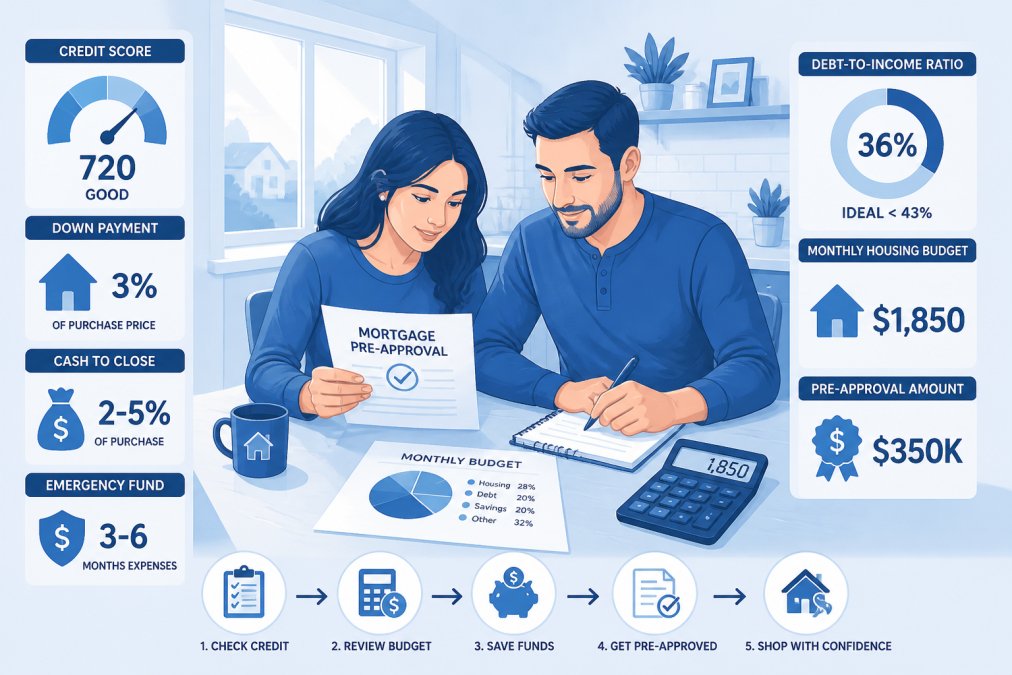
Review your credit report and credit score. Your credit score determines the interest rates you'll qualify for, and even a small difference can cost tens of thousands over the life of a loan. Pull your credit report from all three bureaus (Equifax, Experian, TransUnion) and check for errors. Most lenders prefer a credit score of 620 or higher for conventional loans.
Calculate your debt-to-income ratio, the percentage of your gross monthly income that goes toward debt payments. Lenders typically want to see a ratio below 43 percent. Add up all monthly debt obligations and divide by your gross monthly income. If your ratio is too high, pay down debt before applying.
Gather documentation of your financial history. Lenders will ask for pay stubs, tax returns (typically the last two years), bank statements, and employment verification. Start this process early so you're not scrambling when you find the right home.
Save for a down payment. While many first-time buyer programs allow 3 to 5 percent down, aim to save at least this amount plus closing costs. The lower your down payment, the higher your monthly payment and interest costs over time.
Understanding the Pre-Approval Process for Arizona Mortgages
A pre-approval letter is your first real step toward becoming a serious buyer. Contact lenders and request pre-approval by providing financial information. The lender will review your credit, income, and assets within 3 to 5 business days and issue a pre-approval letter stating the maximum amount you're approved to borrow.
Understand the difference between pre-qualification and pre-approval. Pre-qualification is informal; pre-approval is formal, with verified information and a committed lending amount. In Arizona's competitive market, sellers want to see a pre-approval letter.
Shop around with multiple lenders. Interest rates and fees vary significantly between banks, credit unions, and mortgage brokers. Get quotes from at least three lenders and compare rates, origination fees, and closing costs. Even a 0.25 percent difference in interest rate adds up to thousands over 30 years.
Know your pre-approval limits and stick to them. Just because you're approved for a certain amount doesn't mean you should spend it all. Calculate what monthly payment you're comfortable with and work backward to find your actual budget.
Arizona First Time Home Buyer Programs and Down Payment Assistance
Arizona offers several programs designed to help first-time home buyers get into homes with less cash upfront.
The Federal Housing Administration (FHA) loan program allows borrowers to put down as little as 3.5 percent on a primary residence. FHA loans are backed by the government, making lenders willing to approve borrowers with lower credit scores and higher debt-to-income ratios. You'll pay mortgage insurance premiums (MIP) on top of your regular payment.
The U.S. Department of Veterans Affairs (VA) loan program offers zero-down financing for eligible veterans and active-duty service members. If you qualify, this is one of the best programs available, no down payment, no private mortgage insurance, and favorable interest rates.
The USDA Rural Development Loan program provides zero-down financing for homes in eligible rural areas. Check the USDA's eligibility map to see if your target property qualifies.
Arizona's First-Time Home Buyer Tax Credit allows eligible first-time buyers to claim a tax credit on their state income tax return. Consult a tax professional to see if you qualify. This tax benefit can help offset closing costs.
Many Arizona nonprofits and community organizations offer down payment assistance grants or low-interest loans. Organizations like the Community Development Trust administer programs that can cover 2 to 10 percent of your down payment. These programs often require homebuyer education classes but can be a game-changer for buyers without savings.
What to Expect: Closing Costs for Buyers in AZ
Closing costs are the fees you pay at the end of the home-buying process. In Arizona, closing costs typically range from 2 to 5 percent of the purchase price.
Common closing costs include origination fees, appraisal fees, title insurance, property taxes (prorated based on your purchase date), homeowners insurance, and recording fees. Arizona also charges transfer taxes, which vary by county and municipality. Ask your lender or real estate agent for a Closing Disclosure form, which itemizes all costs and must be provided at least three days before closing.
Negotiate closing costs with the seller. In many cases, sellers are willing to cover some or all of the buyer's closing costs as part of the purchase agreement. If you have limited cash, ask your real estate agent whether it's realistic to request seller concessions in the current market.
Some closing costs can be rolled into your loan amount, which means you don't pay them upfront but you pay interest on them over time. This increases your total loan amount and monthly payment.
Gilbert Real Estate Market Specifics: HOA, Schools, and Commute Impact
Gilbert's housing market has unique characteristics that affect home value, affordability, and your long-term satisfaction.
Most homes in Gilbert are part of homeowners associations (HOAs). HOA fees typically range from 100 to 300 dollars per month, depending on the community and amenities. Before making an offer, review the HOA documents, including the budget, reserve fund, and any planned special assessments. A well-managed HOA with healthy reserves is a sign of a stable community.
School districts significantly impact home values in Gilbert. The Gilbert Unified School District is known for strong academic performance. Homes near highly-rated schools command higher prices, even if you don't have school-age children. If you're buying with the intention to resell, proximity to good schools is an investment factor.
Commute times to major employment centers matter for your quality of life and resale value. Gilbert is part of the greater Phoenix metropolitan area, and many residents commute to downtown Phoenix, Scottsdale, or the tech corridor in Chandler and Tempe. Research typical commute times during rush hour and consider proximity to major highways like the Loop 202 and US-60.
Property tax rates in Arizona are among the lowest in the nation, but Gilbert residents may also pay special assessments in some master-planned communities. These Mello-Roos assessments can add 100 to 200 dollars or more to your monthly payment. Always ask your real estate agent whether a property is subject to special assessments.
Making Your Offer Competitive in Gilbert's Housing Market
Gilbert's housing market has been competitive, with homes often receiving multiple offers and selling quickly. Making your offer stand out requires strategy beyond just offering the highest price.

Get your pre-approval letter in order before submitting an offer. Sellers know that pre-approved buyers are serious and less likely to fall through.
Make a strong earnest money deposit. Earnest money is the deposit you put down when you make an offer, showing good faith. In Arizona, earnest money deposits are typically 1 to 3 percent of the purchase price. A larger deposit signals confidence and commitment.
Offer a competitive price based on recent comparable sales. Your real estate agent should provide a comparative market analysis (CMA) showing what similar homes have sold for recently. Price your offer competitively but realistically.
Include favorable terms beyond price. If the seller is motivated, you might offer a shorter closing timeline, fewer contingencies, or a longer closing period if they need time to find their next home.
Write a personal letter to the seller. Some sellers respond to emotional appeals. A brief letter explaining why you love the home can sometimes sway a seller, especially if your offer is comparable to others. Keep it genuine and brief.
Be prepared to walk away if the price gets too high. Know your maximum price before you start bidding and stick to it. There will always be other homes.
Home Inspection, Appraisal, and the Path to Closing
Once your offer is accepted, you enter the inspection and appraisal phase. This is where you verify that the home is worth what you're paying and that there are no serious hidden problems.
Schedule a home inspection within 7 to 10 days of your offer being accepted. A professional home inspector will examine the roof, foundation, electrical system, plumbing, HVAC, and other major components. The inspection typically takes 2 to 3 hours and costs 300 to 500 dollars. Attend the inspection if possible.
Review the inspection report carefully. Minor issues like worn caulk or aging appliances are normal. Major issues like foundation cracks, roof leaks, or electrical problems are red flags. Decide whether you want to request repairs, ask for a credit toward closing costs, or renegotiate the price.
The appraisal is ordered by your lender to verify that the home's value supports the loan amount. If the appraisal comes in lower than your purchase price, you can renegotiate the price with the seller, increase your down payment, or walk away if your lender won't approve the higher amount.
Finalize your homeowners insurance before closing. Your lender requires proof of insurance before they'll fund the loan. Shop around with multiple insurance companies to get competitive quotes.
Review your Closing Disclosure at least three days before closing. Compare it to the initial estimate you received and ask your lender about any changes or unexpected fees.
At closing, you'll sign documents, transfer funds, and receive the keys to your new home. The closing process typically takes 1 to 2 hours. After closing, the deed is recorded with the county, and you officially own the home.
Conclusion
Buying your first home in Gilbert is an exciting milestone, and the process doesn't have to be overwhelming when you understand each step. From financial preparation and pre-approval through closing, knowing what to expect helps you make confident decisions and avoid costly mistakes.
Bernie Krause understands the Gilbert market intimately and can guide you through every stage of this journey. With expertise in local neighborhoods, HOA communities, school district impacts, and commute logistics, Bernie provides the personalized support first-time buyers need. Whether you're navigating pre-approval, evaluating homes in master-planned communities, or negotiating offers in a competitive market, working with a local agent who knows the East Valley inside and out makes the difference. Contact Bernie Krause to start your home-buying journey with expert guidance tailored to Gilbert's unique market.
Frequently Asked Questions
What credit score do I need to buy a house in Arizona?
Most conventional mortgage lenders require a minimum credit score of 620, though scores of 740 or higher typically qualify for better interest rates. FHA loans may accept scores as low as 580 with a 10% down payment. Your score affects not just approval but your loan terms, so checking your credit report early and addressing errors matters. Arizona lenders follow federal lending standards, and your score is one of several factors in their decision.
What is the 3-3-3 rule for buying a house?
The 3-3-3 rule is a guideline suggesting you spend no more than 3 times your annual income on a home, put down 3% minimum, and expect to spend 3% of the purchase price on closing costs. While helpful as a starting point, this rule is flexible, many buyers spend more or less depending on their debt-to-income ratio, local market conditions, and available down payment assistance programs. Use it as a rough benchmark, not a hard rule.
Are there specific first-time home buyer grants available in Arizona?
Arizona offers several first-time home buyer programs, including down payment assistance grants through state and local housing agencies, FHA loans with lower down payment requirements, and some employer-sponsored homeownership programs. Eligibility varies by income level, credit score, and location. Contact the Arizona Department of Housing or a local housing authority to explore current programs; many have income limits and require pre-approval to qualify.
How much should I budget for closing costs in Gilbert, AZ?
Closing costs typically range from 2% to 5% of your home's purchase price and include appraisal fees, title insurance, escrow, underwriting, and homeowners insurance. In Gilbert, costs align with Arizona state standards. Your loan estimate (provided after pre-approval) will detail all expected costs. Many first-time buyers don't realize closing costs exist; budgeting for them early prevents last-minute surprises and helps you determine your true affordability.
What are the biggest mistakes first-time buyers make in the Arizona market?
Common mistakes include not getting pre-approved before house hunting, underestimating closing costs and HOA fees, ignoring property taxes and special assessment districts, making large purchases on credit before closing (which hurts your debt-to-income ratio), and skipping the home inspection to save money. Gilbert's master-planned communities often have HOA costs that surprise buyers; always factor these into your budget. Working with a local agent who knows the East Valley market helps avoid these pitfalls.
How does the Gilbert housing market differ from the rest of the Phoenix metro area?
Gilbert is one of Arizona's fastest-growing suburbs with strong school districts, master-planned communities, and significant HOA presence. Properties here often command higher prices than outer Phoenix areas due to reputation and amenities, but lower than central Phoenix. HOA fees and special assessment districts (Mello-Roos) are common and can add $200-$400+ monthly to your payment. Commute times to tech jobs in Tempe and Chandler are shorter, making it attractive to young professionals relocating to Arizona.
What should I look for during a home inspection in Gilbert?
Inspectors examine structural integrity, roof condition, HVAC systems, plumbing, electrical, and foundation. In Gilbert's desert climate, pay special attention to cooling system capacity, pool condition (if applicable), and any signs of water damage. Review the inspection report carefully and negotiate repairs or credits with the seller if major issues arise. An inspection contingency protects you, use it. Never skip this step to speed up closing; it's your safeguard before you commit to the purchase.
This article was written using GrandRanker