 ultimate-guide
Are Saltwater Pools Worth It in Arizona Luxury Homes?
Last Updated: October 26, 2026
Quick Summary
Saltwater pools are worth it in Arizona luxury homes when owners value softer water and less manual chlorine handling and can accept the climate-specific upkeep. Desert evaporation concentrates salt, hard fill water causes scaling, and the salt cell is a major recurring replacement cost.
- Evaporation leaves salt behind, so salinity creeps up and needs periodic partial drains.
- Test salinity weekly in summer and pH two to three times weekly.
- Hard fill water raises calcium, so test monthly and dilute by partial drain if it climbs.
- Salt cells are consumables, and cell replacement is the largest recurring equipment expense.
- Check that heaters, pumps, railings and lights are rated for saltwater use.
Table of Contents
- Why Saltwater Pools Are Gaining Ground in Arizona Luxury Homes
- Saltwater Pool vs. Chlorine Pool: What Actually Changes Day to Day
- How Arizona Heat, Evaporation and Water Chemistry Affect a Saltwater Pool
- Saltwater Pool Maintenance Costs for a Luxury Home
- Saltwater Pool Equipment and Corrosion: What Owners Should Plan For
- How a Saltwater Pool Affects Pool Home Value
- Choosing a Saltwater System for Your Arizona Home and Next Step
- Frequently Asked Questions
Why Saltwater Pools Are Gaining Ground in Arizona Luxury Homes
Bernie Krause is a real estate agent serving the East Valley. A saltwater pool is a pool sanitized by a salt chlorine generator, which converts dissolved salt into chlorine in the water rather than requiring the owner to add liquid or tablet chlorine by hand. Buyers in the luxury segment often ask whether that conversion is worth the setup and upkeep, and the answer depends on how the pool will be used.
The appeal comes down to convenience and water feel. Owners who host often want a pool that stays clear without constant chemical handling, and many describe the water as softer than traditional chlorine. Arizona Department of Water Resources pool and water use guidance
Saltwater Pool vs. Chlorine Pool: What Actually Changes Day to Day
The practical difference is in routine, not in the basic goal of killing bacteria. A traditional chlorine pool needs regular dosing of chlorine, along with checks of pH and alkalinity. A saltwater pool uses a salt cell that produces chlorine on demand, so the owner adds salt periodically and monitors the generator output.
Day to day, saltwater pools tend to require fewer manual chemical additions, though they still need testing and balancing. Many owners report that the water feels gentler on the skin and eyes, which is a common reason families choose them. The benefit is real but not total: saltwater systems still produce chlorine, so the pool needs the same attention to water chemistry that any pool does.
How Arizona Heat, Evaporation and Water Chemistry Affect a Saltwater Pool
Arizona is not a mild-climate pool market, and a saltwater system behaves differently here than it does in humid or temperate regions. The single most important mechanism to understand is this: when pool water evaporates, the salt stays behind. Only fresh water leaves. So every top-off with hose water adds volume without removing salinity, and over a season of heavy evaporation, salt concentration creeps upward. Most salt chlorine generators are designed to run in a salinity band of roughly 2,700 to 3,400 parts per million, and a system that drifts above its range can trip high-salt alarms, stress the cell, and taste noticeably salty.
Evaporation itself is the driver. In the desert, a pool can lose a substantial fraction of an inch of water per day in peak summer, and wind exposure on an open, unlandscaped lot makes it worse. That means an owner is effectively replacing a large share of the pool's volume across a season, which is why salinity, calcium hardness, and stabilizer all drift together. Hard fill water common across the Phoenix metro adds calcium and total dissolved solids with every top-off, raising scaling risk on the cell plates, tile line, and heater. A saltwater pool in this climate is therefore a water-balance management job as much as a sanitation job.
The practical schedule most desert pool professionals recommend looks like this:
- Salinity: test weekly in summer, biweekly in shoulder seasons. Confirm the generator's target band and keep salt on hand for the rare low reading after heavy rain or a partial drain.
- pH: test two to three times per week in summer. Heat, aeration from water features, and the generator's own chemistry push pH up, and high pH is the most common cause of scaling and cloudy water.
- Calcium hardness: test monthly. Hard fill water raises it over time; if it climbs too high, the only real remedy is dilution through partial drain and refill.
- Cyanuric acid (stabilizer): test monthly. Stabilizer protects chlorine from sunlight, but too much of it, common in pools that rely on tablets or stabilized shock, locks chlorine in and forces a drain. Saltwater pools still need this monitored.
- Total dissolved solids and phosphates: test quarterly, especially before summer.
Seasonality matters too. Chlorine demand peaks in June through September, when intense sun and high water temperatures burn off sanitizer quickly; generator output often needs to be raised, and the cell runs longer. In winter, when many owners still keep the pool open for spa use and entertaining, demand drops and output should be dialed back to avoid over-chlorination. A variable-speed pump running longer at lower speed helps both circulation and energy use, and it keeps the generator's flow switch satisfied without the noise of a single-speed pump at full tilt.
Arizona Department of Water Resources pool and water use guidance
None of this makes a saltwater pool harder than a traditional one, it makes the maintenance climate-specific. The owner who understands evaporation-driven salinity creep and hard-water scaling will spend less, replace cells less often, and keep the water feeling the way they expected when they bought the system.
Saltwater Pool Maintenance Costs for a Luxury Home
The cost structure of a saltwater pool has four parts:
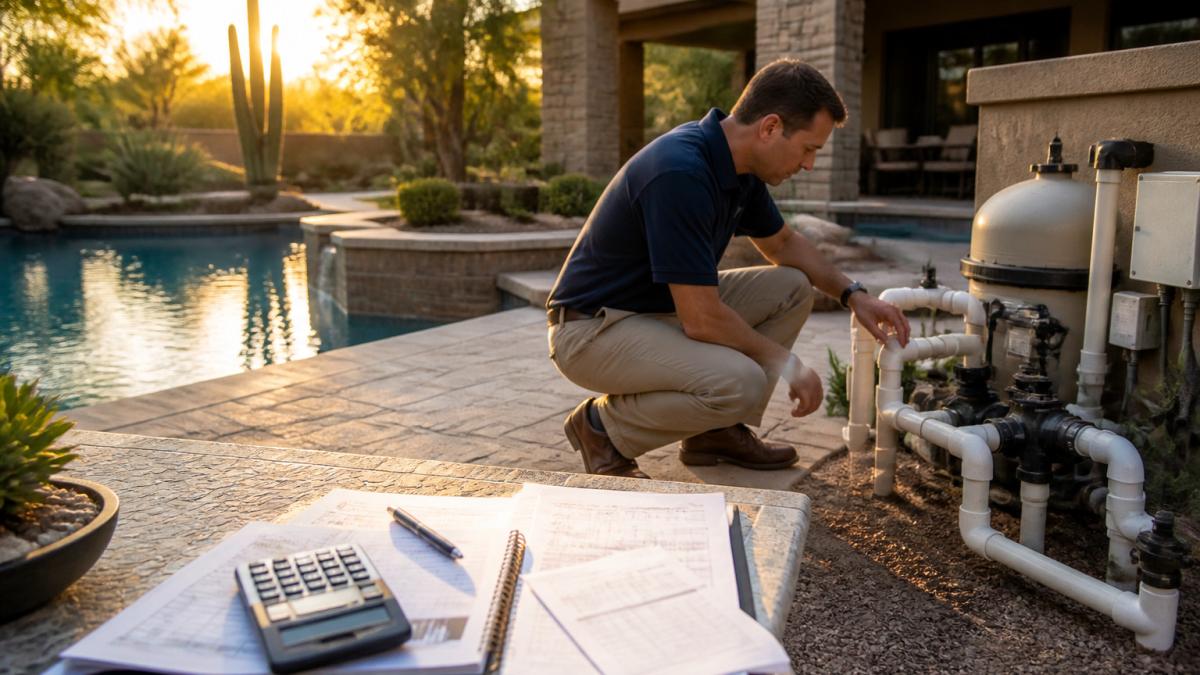
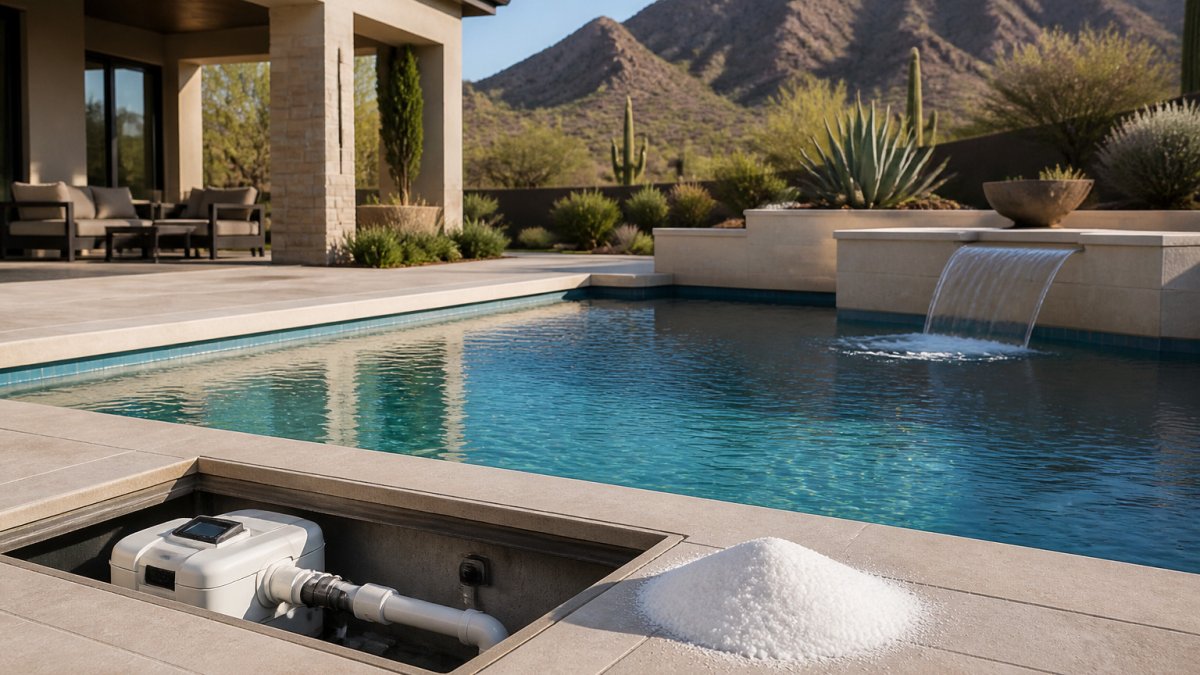
- Upfront equipment. A salt chlorine generator system, cell, controller, and power supply, is typically the main added cost versus a traditional chlorine setup. Installed pricing varies widely with pool volume, cell capacity, and whether the panel is integrated with existing automation. For a luxury pool with a spa and water features, the generator must be sized to the whole body of water, not just the main pool, which pushes the equipment toward the larger end of the range.
- Salt and chemicals. Bagged pool salt is inexpensive per bag, but a desert pool that loses water to evaporation and occasionally needs a partial drain will buy more of it than a mild-climate owner expects. Muriatic acid for pH control is a recurring line item in hard-water markets, and it is often the largest chemical expense in a saltwater pool.
- Cell replacement. This is the big one. A salt cell is a consumable, it wears out as it produces chlorine, and replacement is the largest single recurring equipment expense in a saltwater system. Cell life depends on run hours, water chemistry, and scaling; a cell that is regularly cleaned of calcium scale lasts longer than one that is ignored. Before buying a pool-equipped home, ask for the cell's install date, its rated life, and the warranty terms, because a cell near the end of its life is a real cost the buyer inherits.
- Service and repairs. Pump, filter, heater, automation, and lighting service apply to any pool. Luxury features, spas, waterfalls, laminar jets, in-floor cleaning, and automation, multiply the equipment that needs attention, and salt-rated components cost more than standard ones.
A useful way to frame the comparison: a traditional chlorine pool front-loads cost into ongoing chemical purchases and manual labor, while a saltwater pool front-loads cost into equipment and then spreads it across salt, acid, electricity for the cell, and periodic cell replacement. Neither is automatically cheaper. The saltwater system tends to win on convenience and water feel; the traditional system can win on simplicity and lower equipment outlay. For a luxury home where the owner values a resort-style experience and hands-off operation, the saltwater premium is often judged worth it, but it should be a deliberate budget line, not a surprise.
For a pool-equipped home you are considering, Flat Fee MLS Services for Luxury Homes explains how different selling models affect the total cost of a sale, which can matter when ongoing pool expenses are part of your budget.
The article breaks down the four main cost areas of a saltwater pool, which a reader can compare at a glance:
| Cost area | What it covers | Note |
|---|---|---|
| Upfront equipment | Salt chlorine generator: cell, controller, power supply | Usually the main added cost versus chlorine |
| Salt and chemicals | Bagged salt and muriatic acid for pH | Acid is often the largest chemical expense |
| Cell replacement | Salt cell wears out as it produces chlorine | Largest single recurring equipment expense |
| Service and repairs | Pump, filter, heater, automation, lighting | Salt-rated components cost more |
Saltwater Pool Equipment and Corrosion: What Owners Should Plan For
Salt is corrosive to certain metals, so equipment choice and placement matter. Owners should check that heaters, pumps, railings, ladders and light fixtures are rated for saltwater use. Stainless steel and marine-grade materials handle salt better than standard steel or untreated metal.
Salt spray and runoff can also reach nearby landscaping and hardscape. Concrete, pavers and some plants may react to salt splash and drainage, so layout and irrigation should account for it. Planning this at the design stage costs less than correcting it later.
How a Saltwater Pool Affects Pool Home Value
If you are considering upgrades before a sale, How Home Improvements Affect Property Valuation covers how improvements can influence valuation and tax assessment in Maricopa County. Condos vs Single Family Homes in East Valley is also useful if you are comparing property types, since HOA rules and resale value differ.
Bernie Krause has sold 9 properties, including homes in Phoenix and Gilbert. What Upgrades Increase Home Value in Gilbert 2026 looks at which upgrades tend to matter most locally.
Choosing a Saltwater System for Your Arizona Home and Next Step
A saltwater pool can suit an Arizona luxury home when the owner is prepared for the water chemistry, equipment care and corrosion planning it requires. The right choice depends on your budget, how often you will use the pool and how the property fits your plans.
If you are buying or selling a home in the East Valley, Bernie Krause can help you navigate the process. Luxury Homes for Sale East Valley with Pools is a good place to start looking at available homes.
Frequently Asked Questions
Are saltwater pools cheaper to maintain?
Saltwater pools usually cut the weekly chemical routine because the salt cell generates chlorine from dissolved salt, so owners buy less chlorine in bulk. Maintenance is not free, though. The salt cell typically needs cleaning several times a year and replacing every few years, and salt, pH adjusters and balancing chemicals still cost money. Actual spending depends on pool size, sun exposure, splash-out and how often the pool is used, so ask a local pool service for a quote based on your specific pool before comparing the two systems.
Do saltwater pools need less maintenance than chlorine pools?
They need less hands-on chemical handling but more equipment attention. A chlorine pool requires regular manual dosing and shock treatments. A saltwater pool relies on the generator to produce sanitizer, which means owners must keep salt concentration and pH in range and clean the salt cell on schedule. In Arizona's heat and evaporation, the daily routine is easier, but water chemistry still needs regular testing to avoid scale and corrosion.
Are saltwater pools better for your skin and eyes?
Many swimmers report that saltwater feels softer and causes less eye and skin irritation than heavily chlorinated water, because chlorine levels in a salt system tend to stay lower and steadier. This is a comfort difference, not a medical guarantee. Saltwater pools still contain chlorine, and poor water balance can irritate skin and eyes regardless of system type. Anyone with a specific skin or respiratory condition should check with a physician.
Do pools add value to a home in Arizona?
A well-maintained pool can make a home more appealing to buyers in warm climates, but it does not add value automatically. Buyers weigh the pool's condition, size, equipment age and how well it fits the yard and neighborhood. A saltwater system can be a selling point when it is documented and working well. For a current read on how pool features affect a specific home's price and sale timing, a local agent can review recent comparable sales with you.