 comparison
Home Seller Alternatives to Justin Bemis: 2026 Guide
Table of Contents
- Understanding Your Home Seller Alternatives to Justin Bemis
- Real Estate Agent Commission Alternatives: What You Should Know
- Flat Fee MLS Services: A Cost-Effective Path to Selling
- For Sale By Owner (FSBO) Guide: Selling Without an Agent
- iBuyer Companies Reviews: Quick Sale Alternatives
- Comparing Home Seller Alternatives: Which Path Fits Your Situation
- Working with a Local East Valley Real Estate Expert
- Conclusion: Choosing Your Home Seller Strategy
Home Seller Alternatives to Justin Bemis: 2026 Guide
Last Updated: July 29, 2026
When you're ready to sell your home in the East Valley, you face a critical decision: which path gets you the best outcome? The real estate market has changed dramatically since 2024, and Justin Bemis alternatives for home sellers have expanded well beyond traditional full-service agents. This guide breaks down the actual options available to you, from flat-fee MLS services to iBuyers to going solo, with honest analysis of what each approach costs you, what it gains you, and who it's actually best for.
At Bernie Krause, we've helped homeowners navigate this exact decision. The key insight most sellers miss is this: the "best" option isn't about the agent's reputation or the lowest commission. It's about matching your situation, your timeline, your market knowledge, and your willingness to handle details yourself to the right selling strategy.
Understanding Your Home Seller Alternatives to Justin Bemis
The landscape of home selling has fractured into distinct models, each with fundamentally different economics and trade-offs. Justin Bemis alternatives for home sellers aren't all created equal, and the wrong choice can cost you thousands in lost equity or months of unnecessary waiting.
Traditional full-service agents charge around 5-6% in commissions. Everything else is defined by how much of that work and cost you're willing to absorb yourself. You're paying for market analysis, pricing strategy, buyer qualification, negotiation support, transaction management, and legal coordination. Some alternatives handle all of that. Others handle almost none of it. The question is: which parts do you actually need help with?
Real Estate Agent Commission Alternatives: What You Should Know
Full-Service Agents vs. Discount Brokers
A full-service agent typically charges 5-6% commission and handles everything: market analysis, listing presentation, marketing, showing coordination, offer negotiation, inspection coordination, appraisal review, and closing logistics.
Discount brokers charge 2-3% commission instead, doing the same core work with fewer frills. On a $400,000 home, a 3% commission savings is $12,000. But if a discount broker's lower profile results in fewer qualified buyers seeing your listing, you might sell for $15,000 less. The math flips quickly.
Local market expertise genuinely matters. An agent who knows the East Valley market intimately, the neighborhoods where inventory is tight, the builders whose homes appreciate faster, the buyer demographics in Chandler versus Gilbert, can price your home more accurately and market it to the right audience.
How to Evaluate Agent Expertise in Your Local Market
Ask a prospective agent three specific questions: How many homes have you sold in this ZIP code in the last 12 months? What's the average days-on-market for homes like yours? What's the current price per square foot trend?
If they can't answer with specific numbers, they don't have the data. A genuinely local expert will have these numbers memorized or pull them up immediately from their own transaction history.
A 15-year veteran who's sold 200 homes in your area carries different weight than a 2-year agent who's sold 50 homes across the entire valley. The veteran understands seasonal patterns, builder reputation cycles, and buyer psychology in ways that only come from repetition.
Flat Fee MLS Services: A Cost-Effective Path to Selling
What Flat Fee MLS Services Include
Flat-fee MLS services let you list your home on the Multiple Listing Service for a fixed fee, typically $300 to $1,500, instead of paying a percentage commission. You handle the marketing, showing coordination, and buyer interaction yourself. Your listing appears in all the places buyers and agents look: the MLS, Zillow, Redfin, realtor.com, and dozens of other sites. You get basic listing support and access to transaction documents but not professional photography, staging consultation, market analysis, or negotiation support.
When Flat Fee MLS Makes Sense for Home Sellers
Flat-fee MLS works best when you have significant real estate knowledge, your home is in a strong buyer's market with high demand, and you have time to manage the process yourself.
If you're selling a $250,000 home in a neighborhood where properties move in 20 days regardless of marketing quality, flat-fee MLS is smart. Buyer's agents will bring qualified buyers anyway. If you're selling a $550,000 home in a slower market or a home with unusual features, flat-fee MLS becomes riskier. You might save commission but lose thousands in negotiating power or final sale price.
The hidden cost is time. Coordinating 30 showings, responding to inquiries, and managing inspection follow-ups takes 10-15 hours per week for 30-60 days. If your time is worth $50+ per hour, that's $5,000-$15,000 in opportunity cost.
For Sale By Owner (FSBO) Guide: Selling Without an Agent
FSBO Responsibilities and Legal Requirements
When you sell your home yourself, you become responsible for everything: pricing competitively, marketing, showing the home, handling inquiries, negotiating offers, managing inspections and appraisals, coordinating with the buyer's lender, and ensuring all legal documents are correct.
Arizona requires certain disclosures on every residential sale: property condition disclosure, lead-based paint disclosure (for homes built before 1978), HOA disclosures (if applicable), and various other forms. You must understand contracts, earnest money requirements, contingencies, closing timelines, and what happens if a buyer backs out.
Many FSBO sellers hire a real estate attorney to review contracts and handle closing coordination ($500-$1,500). You might also hire a professional photographer ($150-$300) and a home inspector for a pre-inspection report ($300-$500).
Common FSBO Challenges and How to Address Them
The biggest challenge is pricing. Agents have access to the MLS and sold-data tools. You have Zillow, which uses algorithms that are often wrong. Solution: hire an appraiser ($300-$500) to give you a professional opinion of value.
The second challenge is buyer qualification. A buyer's agent filters out unqualified buyers before they waste your time. Require pre-approval letters from any buyer before investing time in negotiations.
The third challenge is negotiation. An agent represents the seller and handles the emotional parts. When you negotiate directly with a buyer, emotions run high. Solution: if you get an offer, consider hiring a real estate attorney or transaction coordinator to review it and suggest negotiation strategy.
iBuyer Companies Reviews: Quick Sale Alternatives
How iBuyers Differ from Traditional Home Sales
iBuyer companies like Opendoor, Offerpad, and Zillow Offers buy your home directly. You get an offer within days, not weeks. You close in 7-14 days, not 30-45. The process is entirely digital with no showings, no inspections (they do them), and no negotiation.
The catch is the price. iBuyers discount homes by 5-15% below market value to account for acquisition costs, holding costs, and the risk they take by buying before they've found a buyer. On a $400,000 home, that's $20,000-$60,000 less than you might get on the open market.
Why would you accept that discount? Speed. If you're relocating for a job with a start date in two weeks, or you need to close before your lease ends, or you're in financial distress and need cash immediately, the discount is worth it.
Evaluating iBuyer Offers and Trade-Offs
When you get an iBuyer offer, understand what you're comparing it to. The offer is not "what your home is worth." It's "what we'll pay you for the convenience of a quick close."
Run the numbers carefully. If an iBuyer offers $360,000 and a traditional sale might net you $400,000 after 6 weeks of marketing and 2 months of closing, the iBuyer saved you 8 weeks but cost you $40,000. Is your time worth $5,000 per week? For most people, no.
Check the iBuyer's reputation on the Better Business Bureau for complaints about inspection findings that lower offers after the initial bid or aggressive negotiation on repair costs.
| Option | Timeline | Price | Best For |
|---|---|---|---|
| Full-service agent | 30-60 days | Market rate | Sellers with time and want max price |
| Discount broker | 30-60 days | Market rate | Price-conscious sellers who know their market |
| Flat-fee MLS | 30-60 days | Market rate | Knowledgeable sellers with strong markets |
| FSBO | 30-90 days | Market rate (if priced right) | Experienced sellers with time |
| iBuyer | 7-14 days | 5-15% discount | Sellers needing speed over price |
Comparing Home Seller Alternatives: Which Path Fits Your Situation
Speed vs. Maximum Profit: Your Priority Matters
This is the core tension in every home sale. You can optimize for speed or for price, but rarely both.
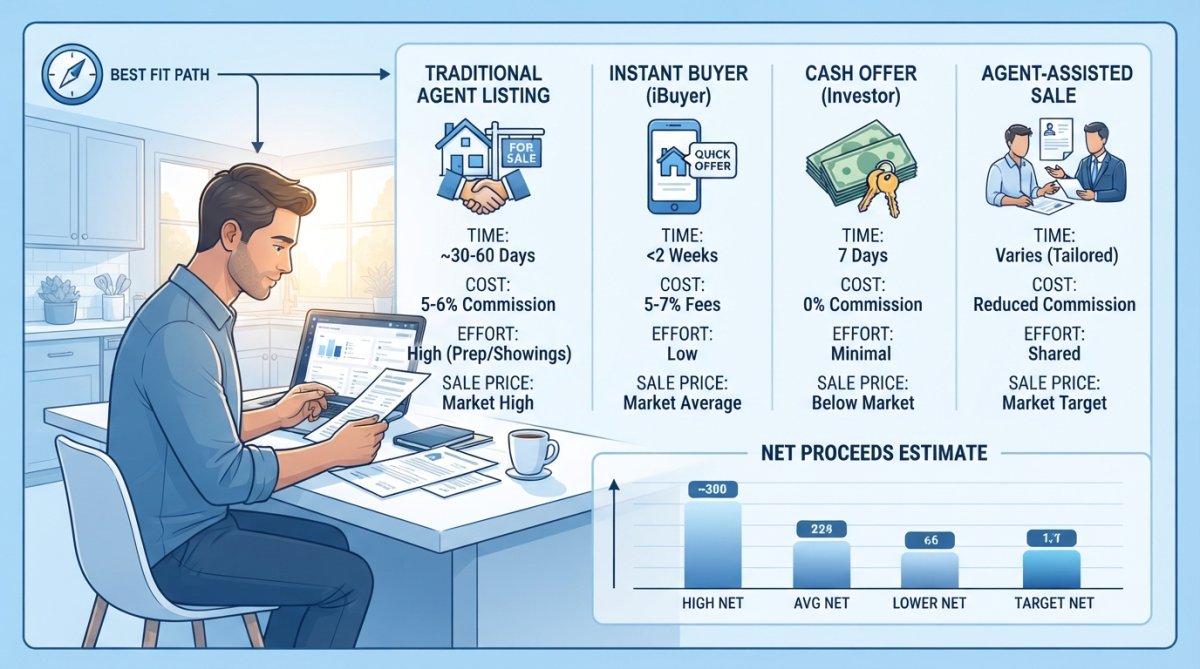
If speed is your priority, iBuyers win with a two-week close. Flat-fee MLS with an experienced buyer comes second at 30 days in a hot market. Traditional agents take 45-60 days because they're marketing to the widest possible buyer pool.
If maximum profit is your priority, traditional full-service agents win, but only if you choose one who actually knows your market. A local expert can price your home to attract the right buyers, market it strategically, and negotiate harder. That expertise costs commission, but it often results in a higher final price.
Ask yourself honestly: what would change your situation? If you got an offer $15,000 below market but closed in two weeks instead of six, would that be worth it? If the answer is yes, your real priority is speed. If the answer is no, your real priority is price.
Local Market Expertise: When It Adds Real Value
Market expertise matters most in three situations: slow markets, unique homes, and competitive markets.
In a slow market where homes take 60+ days to sell, an agent's pricing strategy and buyer targeting becomes critical. A home priced $10,000 too high might sit for months. In competitive markets where multiple homes are for sale at similar prices, the agent's marketing and buyer agent relationships make the difference. One agent's listing gets 15 showings in the first week. Another's gets 3.
In a hot market where everything sells, agent expertise matters less. Buyers are competing for homes, not the other way around.
Working with a Local East Valley Real Estate Expert
When you choose to work with a full-service agent, local expertise should be your primary filter. The East Valley market, Chandler, Gilbert, Mesa, Apache Junction, has distinct dynamics from the rest of Phoenix. Neighborhoods appreciate at different rates. Buyer demographics vary. Builder reputation matters differently.
Bernie Krause understands the East Valley landscape because he focuses on it exclusively. He knows which neighborhoods are appreciating fastest, where first-time buyers cluster, which builders hold value best, and how to price homes to attract serious buyers.
This focus translates to concrete advantages. When you list with Bernie Krause, your home gets positioned correctly for the actual East Valley buyer. The marketing targets the right audience. Negotiations happen from a position of knowledge about what comparable homes actually sold for in your specific area.
The cost is the standard 5-6% commission. Whether it's worth it depends on your situation: if you have time and market knowledge, probably not. If you need professional handling and want the highest possible price, it's worth serious consideration.
Conclusion: Choosing Your Home Seller Strategy
The right choice depends on three factors: your timeline, your market knowledge, and your willingness to manage details yourself. There's no universally "best" option, only the best option for your specific situation.
If you're relocating fast and need certainty, an iBuyer makes sense despite the discount. If you're selling in a hot market and have time, a flat-fee MLS listing works. If you're selling a unique home in a slow market and want maximum price, a full-service local agent delivers value that justifies the commission.
Bernie Krause offers the expertise and local market knowledge to help you navigate this decision. With years of experience selling homes throughout the East Valley, Bernie provides the market analysis, pricing strategy, and negotiation support that help sellers achieve their goals. Contact Bernie Krause to discuss your specific situation and get a professional perspective on which selling strategy makes sense for your home.
Frequently Asked Questions
What are the main home seller alternatives to using a traditional real estate agent?
Home sellers have several alternatives: flat-fee MLS services (you list on MLS but handle marketing), For Sale By Owner (FSBO) where you manage the entire sale, iBuyer companies that purchase homes directly for quick closings, discount real estate brokers offering reduced commission rates, and hybrid models combining agent support with lower fees. Each alternative trades different elements, cost, time, effort, or market reach, so your choice depends on your priorities and comfort level managing the selling process.
How much can I save with flat fee MLS services compared to traditional agent commission?
Flat fee MLS services typically charge a set fee (often $300-$1,000) to list your property on the MLS and local real estate databases, versus traditional agent commission which ranges based on the sale price. The savings depend on your home's value, on a $400,000 home, traditional commission might cost significantly more than a flat fee. However, flat fee services require you to handle marketing, showings, and negotiations yourself, so the savings come with added responsibility and time investment.
What are the main pros and cons of selling For Sale By Owner (FSBO)?
FSBO advantages include keeping 100% of proceeds (no agent commission), controlling the entire sale process, and setting your own timeline. Disadvantages include limited MLS exposure without an agent, handling all marketing and showings yourself, managing legal paperwork and contracts, missing professional market analysis, and potentially pricing incorrectly. FSBO works best for sellers with real estate knowledge, time availability, and homes in strong markets where buyer demand is high.
Are iBuyer companies a good alternative for selling a home quickly?
iBuyers offer speed and certainty, they purchase homes directly, typically closing in 7-21 days with no contingencies. However, they usually offer 5-15% below market value to account for repairs, holding costs, and resale risk. iBuyers work well if you need a fast sale, can't wait for traditional market listings, or prefer avoiding showings and negotiations. They're less ideal if you want maximum profit or have a property in strong demand where you'd get closer to market value through traditional sale.
How do I know which home seller alternative is right for my situation in the Flagstaff or East Valley market?
Consider three factors: timeline (quick sale favors iBuyers; flexible timeline favors traditional agents or FSBO), effort level (FSBO and flat-fee MLS require significant personal work; full-service agents handle most tasks), and financial priority (FSBO maximizes proceeds; iBuyers sacrifice profit for speed; flat-fee MLS balances cost and control). Research your local market conditions, strong buyer demand makes FSBO or flat-fee viable, while slow markets benefit from professional agent expertise and marketing reach.
Selling your home is one of the largest financial decisions you'll make. The alternative you choose, full-service agent, discount broker, flat-fee MLS, FSBO, or iBuyer, will determine not just the price you receive, but the timeline, stress level, and support you get throughout the process. Take time to evaluate your actual priorities, not just the headline cost savings. The cheapest option isn't always the smartest one.
This article was written using GrandRanker