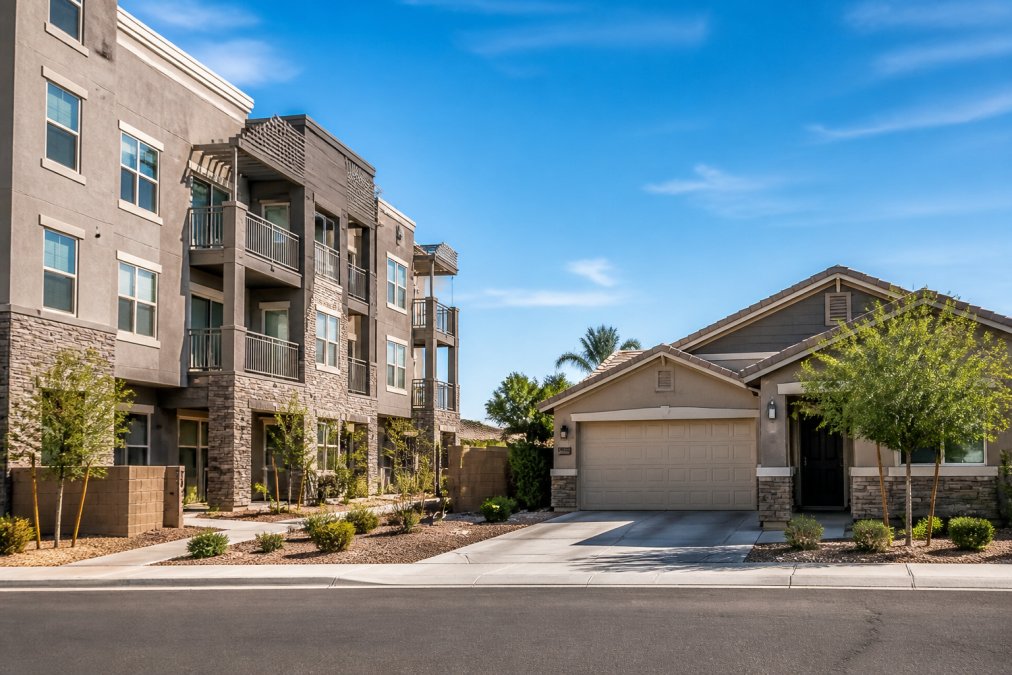
 comparison
Condos vs Single Family Homes in East Valley
Table of Contents
- Condos vs Single Family Homes in East Valley: Quick Comparison
- Upfront Costs and Monthly Payments: Where the Money Goes
- East Valley HOA Fee Averages and What They Cover
- Maintenance Responsibilities: Detached Property vs Attached Housing
- First-Time Home Buyer Programs in Arizona You Should Know
- Insurance, Property Taxes, and Rental Restrictions in the East Valley
- Investment Potential, Resale Value, and Market Liquidity
- Which Property Type Fits Your Lifestyle and Long-Term Plans?
- Frequently Asked Questions
Last Updated: September 16, 2026
Condos vs Single Family Homes in East Valley: Quick Comparison
Choosing between condos vs single family homes in East Valley comes down to one trade-off: land and control, or convenience and a lower entry price. Condos are attached units where an HOA owns and maintains common areas; a detached single-family home sits on its own lot with no shared walls or roof. This guide from Bernie Krause breaks down upfront costs, HOA dues, maintenance, insurance, and resale value.

Here's the short version before the details:
| Factor | Condo | Single-Family Home |
|---|---|---|
| Upfront cost | Lower down payment | Higher down payment |
| Monthly cost | Mortgage plus HOA dues | Mortgage plus self-funded repairs |
| Maintenance | HOA handles exterior | Owner handles everything |
| Privacy and outdoor space | Shared walls, shared amenities | Private lot, own yard |
| Resale pool | Smaller, investor-heavy | Broader owner-occupant demand |
Upfront Costs and Monthly Payments: Where the Money Goes
Condos typically carry a lower purchase price and smaller down payment than detached properties, which is why they attract first-time homebuyers. Condos can qualify for lower down payment programs than many buyers expect. Closing costs apply to both property types and usually run a few percent of the purchase price.
- Condo: mortgage + taxes + insurance + HOA dues
- Single-family: mortgage + taxes + insurance + self-managed repair fund
- Both: closing costs at purchase, plus moving and setup expenses
East Valley HOA Fee Averages and What They Cover
HOA dues are the line item that most often flips the condo-vs-house math, and the one buyers understand least. There is no single East Valley average, because dues scale with what the association maintains. A bare-bones attached community with shared landscaping sits at the low end; a gated community with a pool, clubhouse, fitness center, and guarded entry sits at the high end, a gap of several hundred dollars a month for similar square footage.
-
Landscaping and irrigation of common areas, including desert-adapted plant maintenance
-
Exterior building maintenance, stucco, paint, and roof reserves
-
Pool, spa, clubhouse, and fitness equipment upkeep
-
Common-area water, trash, and sometimes pest control
-
Master insurance policy on the building shell and common structures
-
Reserve fund contributions for future capital repairs
-
Management company fees and legal/accounting costs
-
Interior repairs, appliances, fixtures, and flooring
-
Interior paint and any upgrades you choose
-
In-unit water heater replacement in many associations
-
Special assessments when reserves fall short
Special Assessments and Reserve Funds
A special assessment is a one-time charge the HOA levies when reserves fall short of a major repair, a new roof, repaving, exterior paint, or a failed pool pump and deck. Reserve funds absorb those costs gradually through dues, but not every association keeps them fully funded. Boards pressured to hold dues flat sometimes defer reserve contributions, pushing the bill onto whoever owns the unit when the repair can no longer wait.
How East Valley Cities Differ on HOA Oversight
HOA rules are not uniform across the East Valley. Each city and unincorporated county pocket handles things differently, and the effect shows up in rental caps, short-term rental rules, and architectural enforcement.
- Mesa has a large stock of older attached communities, many with modest dues and lean reserves. Rental caps and investor ratios vary widely from one association to the next, so two Mesa condos a mile apart can have completely different investor appeal.
- Gilbert skews newer, with more amenity-rich master-planned communities and higher dues to match. Architectural review tends to be stricter, which matters if you plan exterior changes.
- Chandler mixes older and newer product, and its larger master-planned communities often layer a master association on top of a sub-association, meaning two sets of dues and two sets of rules.
- Scottsdale communities frequently carry the highest dues in the region because of amenity load and landscaping standards, and some associations restrict short-term rentals more aggressively than their neighbors.
Maintenance Responsibilities: Detached Property vs Attached Housing
Maintenance is the clearest dividing line between a detached property and attached housing. With a condo, the HOA handles structural maintenance, exterior paint, roofing, and common-area landscaping, hence the "maintenance-free" label. You maintain the interior: appliances, fixtures, flooring, and walls.
- Condo owner: interior upkeep, plus HOA dues for shared systems
- Single-family owner: full exterior and interior upkeep, no shared fund
First-Time Home Buyer Programs in Arizona You Should Know
First-time home buyer programs in Arizona can reduce the upfront burden for either property type, and several target buyers who qualify by income and purchase price. They typically take the form of down payment assistance, closing cost help, or below-market interest rates through participating lenders. Eligibility rules, income limits, and available funds change over time, so verify current terms with the administering agency.
Insurance, Property Taxes, and Rental Restrictions in the East Valley
Insurance and property taxes work differently for each property type, and rental restrictions can change the math entirely, this is where the real monthly cost difference often hides.
HO-6 vs HO-3: The Policy Split That Changes Your Premium
A single-family home is typically insured with an HO-3 policy, covering the dwelling, other structures on the lot, personal property, and liability. You insure the full replacement cost of the structure, which is why the premium is higher than a condo policy on similar square footage.
How Property Taxes Are Assessed Differently
Property taxes are assessed on assessed value, and rates differ by county and taxing district, so a condo and a single-family home in the same area can carry different tax bills. Two mechanics matter:
- Assessed value vs. market value. The county assessor sets an assessed value that is generally lower than what you paid, and the tax rate is applied to that figure, not to your purchase price. A condo and a house with the same market value can land on different assessed values depending on how the assessor classifies and values the improvements.
- Land vs. improvements. A detached home's value is split between land and improvements. A condo's value is almost entirely in the improvements, with a fractional interest in common areas. Because land and improvements can be assessed at different effective rates, the two property types do not always scale the same way when values rise.
Rental Caps and Investor Rules in Local HOAs
Many East Valley HOAs cap the percentage of units that may be rented at any one time, and some prohibit short-term rentals outright. These rules live in the CC&Rs and can be amended by the board. If you plan to rent later or are buying as an investment, read the rental provisions first.
The mechanics that trip up investors:
- Rental caps. A community may allow only a set percentage of units to be rented. If the cap is full, you go on a waiting list, and your unit sits owner-occupied until a slot opens. That can take years in a tight community.
- Lease term minimums. Many CC&Rs require leases of six or twelve months, which effectively bans nightly and weekly rentals.
- Short-term rental bans. Some associations prohibit rentals under 30 days outright, which shuts down the Airbnb and VRBO model regardless of what the city allows.
- City-level rules. Short-term rental rules are also set at the city level, and they change. Verify current requirements with the city where the property sits before you count on rental income.
Investment Potential, Resale Value, and Market Liquidity
Investment potential depends less on property type than on location, condition, and buyer demand. Single-family homes generally appeal to a broader pool of owner-occupants, supporting market liquidity and long-term appreciation in established neighborhoods. Condos can appreciate well in desirable areas, but their resale pool is narrower and more sensitive to HOA health, rental restrictions, and dues.
Which Property Type Fits Your Lifestyle and Long-Term Plans?
Match the property to your life, not the market's mood. A condo fits buyers who want maintenance-free living, amenity access, walkability, and a lower entry cost, and who will trade some privacy for convenience. A detached single-family home fits buyers who want a private lot, room to grow, control over repairs, and the broadest resale demand.
Frequently Asked Questions
What are the main differences between owning a condo and a single family home?
A condo is attached housing where you own the interior unit and share ownership of common areas through an HOA. A single family home is a detached property where you own the structure and the lot. That means condo owners pay HOA dues for exterior maintenance and amenity access, while single family owners handle landscaping and structural maintenance themselves. Condos usually cost less upfront but come with monthly fees and CC&Rs that limit how you use the property.
Do condos in the East Valley have higher HOA fees than single family homes?
Yes, typically. Condo HOA dues in the East Valley tend to run higher than single family HOA dues because they cover roof repair, exterior painting, and common areas. Single family HOAs often charge less and focus on shared amenities and community landscaping. Exact East Valley HOA fee averages vary by community and square footage, so ask for the current budget and reserve study before you make an offer on either property type.
Is a condo or a single family home a better investment in the East Valley?
It depends on your goals. Single family homes historically build equity faster and offer stronger resale value because you control the land and the structure. Condos can work well for rental income, but HOA rental restrictions and special assessments can cut into returns. In fast-growing East Valley submarkets, detached properties often see higher appreciation rates, while condos provide lower entry costs and maintenance-free living for buyers who want less responsibility.
What maintenance responsibilities come with a single family home versus a condo?
With a single family home, you are responsible for the roof, HVAC, exterior paint, landscaping, and everything inside and outside the walls. A condo shifts most exterior and structural maintenance to the HOA, which handles common areas, roofs, and sometimes utilities. The trade-off is monthly HOA dues and less control over capital improvements. Budget for single family upkeep, or check the condo's reserve fund instead.
Are there specific down payment assistance programs for condos in the East Valley?
Most first-time home buyer programs in Arizona, including state and local assistance, apply to both condos and single family homes as long as the property meets FHA or conventional loan guidelines. Some condo complexes are not approved for certain loan types, so confirm HOA eligibility before you write an offer. A local lender or agent can walk you through first-time home buyer programs Arizona offers and match them to the specific property you want.